Group History#
Oto-Wa Taiko was founded in 1989 by members of the Ottawa Japanese Community Association. In its early years, the group had no drums of its own and trained on car tires, a method commonly used by beginners in Japan. The name Oto-Wa Taiko reflects both its cultural roots and its artistic philosophy. While it echoes “Ottawa”, its community of origin, it also draws from the Japanese characters oto (音), meaning “sound”, wa (和), meaning “harmony”. The character wa was chosen to represent not only the harmony among members, but also the spiritual connection between players and their drums as they create sound together. Since its founding, Oto-Wa Taiko has delivered over 650 performances across the National Capital Region and in other Canadian cities, including Montreal, Toronto, and Winnipeg. The group has also represented Ottawa internationally, with performances in Sendai, Japan; Washington, D.C.; and Rochester, New York.
Founding Inspiration#
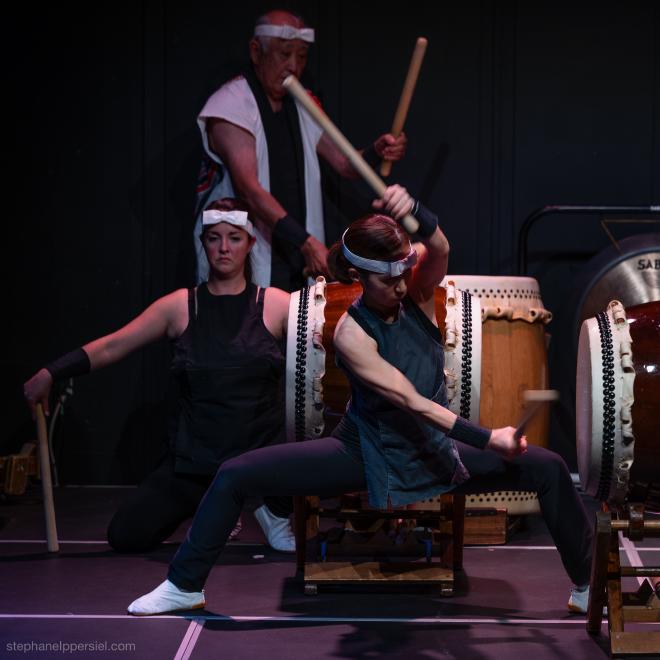
Founded by three members of Ottawa’s Japanese community, our taiko group was created to bring the heartbeat of Japanese drumming to the city. Ever since, we’ve been spreading the joy and energy of taiko throughout the National Capital Region.
Notable History#
Performance for Queen Elizabeth II, Jacques Cartier Park, Gatineau QC, July 1, 1990: Oto-Wa Taiko’s first performance ever was an auspicious one. We started the group in the Fall of 1989, using tires for practice during our initial period of existence. As part of Canada Day celebrations in the National Capital Region, MASC (Multicultural Artists for Students and Communities) booked Oto-Wa Taiko to run percussion workshops on recycled tires. When it was announced that Queen Elizabeth II, who was visiting Canada, would be doing a walk-through, we quickly adapted. With the support of Arashi Daiko from Montreal, we put together a joint performance with both taiko drums and tires.
Performance on Parliament Hill, Ottawa, ON, July 1, 1996: Oto-Wa Taiko performed during Canada Day celebrations as part of a program of entertainment representing different regions of the country and different cultures that make up Canada. This program was broadcast on national television.
Performance for His Imperial Highness Akihito and Empress Michiko of Japan, Japanese Ambassador’s Residence, Ottawa, ON, July 5, 2009: At the start of their visit of their Imperial Highnesses to Canada, a welcome reception was held by the Japanese Ambassador. Oto-Wa Taiko performed a musical welcome to start this event at the ambassador’s residence.
Collaboration with Kamo Tsunamura Daiko, May 2008 and August 2009: Among Oto-Wa Taiko’s many collaborations with other taiko groups, such as Yakudo of Toronto, Arashi Daiko of Montreal, and several joint performances with Indigenous drummers and dancers, the most notable is its partnership with Kamo Tsunamura Daiko from Sendai, Japan. In 2008, Kamo Tsunamura visited Ottawa to perform in Oto-Wa’s concert, and in 2009, Oto-Wa traveled to Sendai to join Kamo Tsunamura’s concert and participated in the Tanabata Festival, the city’s vibrant annual celebration. These exchanges deepened artistic learning, cultural connection, and friendship through the shared spirit of taiko.
Performance on Parliament Hill, Ottawa, ON, July 1, 2019: Oto-Wa Taiko performed during Canada Day celebrations as part of singer K-Naan’s performance of ‘Wavin Flag’, accompanied by the National Arts Centre orchestra, and First Nations, African, and Brazilian drummers. The event was attended by Governor General and by the Prime Minister of Canada, and was broadcast on national television.
Future Goals and Values#
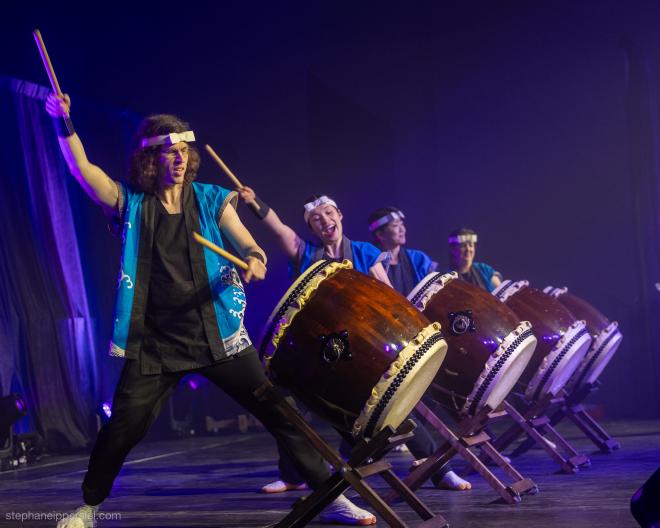
Sharing the joy of taiko, community building, showcasing a Japanese art form
Performance Material Sources#
Other taiko groups and professional players from Japan and North America, Kodo’s shared material and a few original songs.
Taiko Community Mentors in the Group#
- One of our founders, Aki Watanabe, who remains an active member at the age of 90, can mentor people on using kuchi shoga for teaching, including how to use Excel spreadsheets to generate written kuchi shoga.